
Article and tips
No amount of careful portioning will make a whole turkey feel reasonable for two people. The first time I tried, we ate leftovers until December. So I threw tradition onto a sheet pan and discovered something I wish I’d known years ago: a proper Thanksgiving for two isn’t a scaled-down banquet—it’s a smarter, better version of the holiday, with all the crisp edges and none of the chaos.
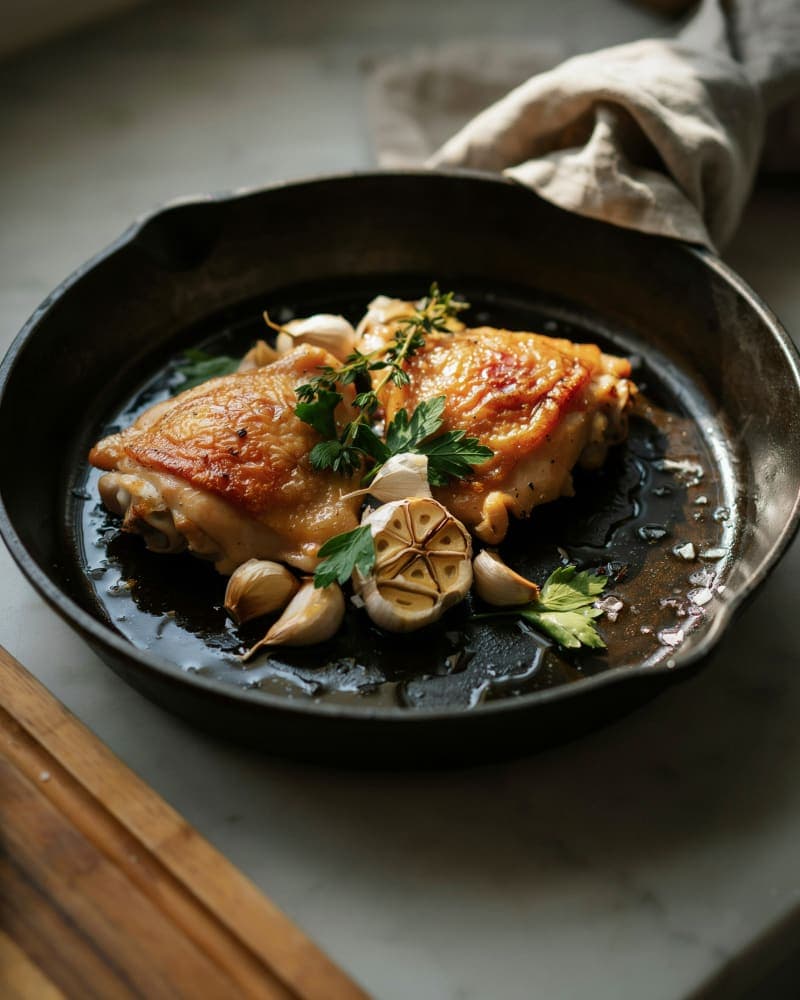
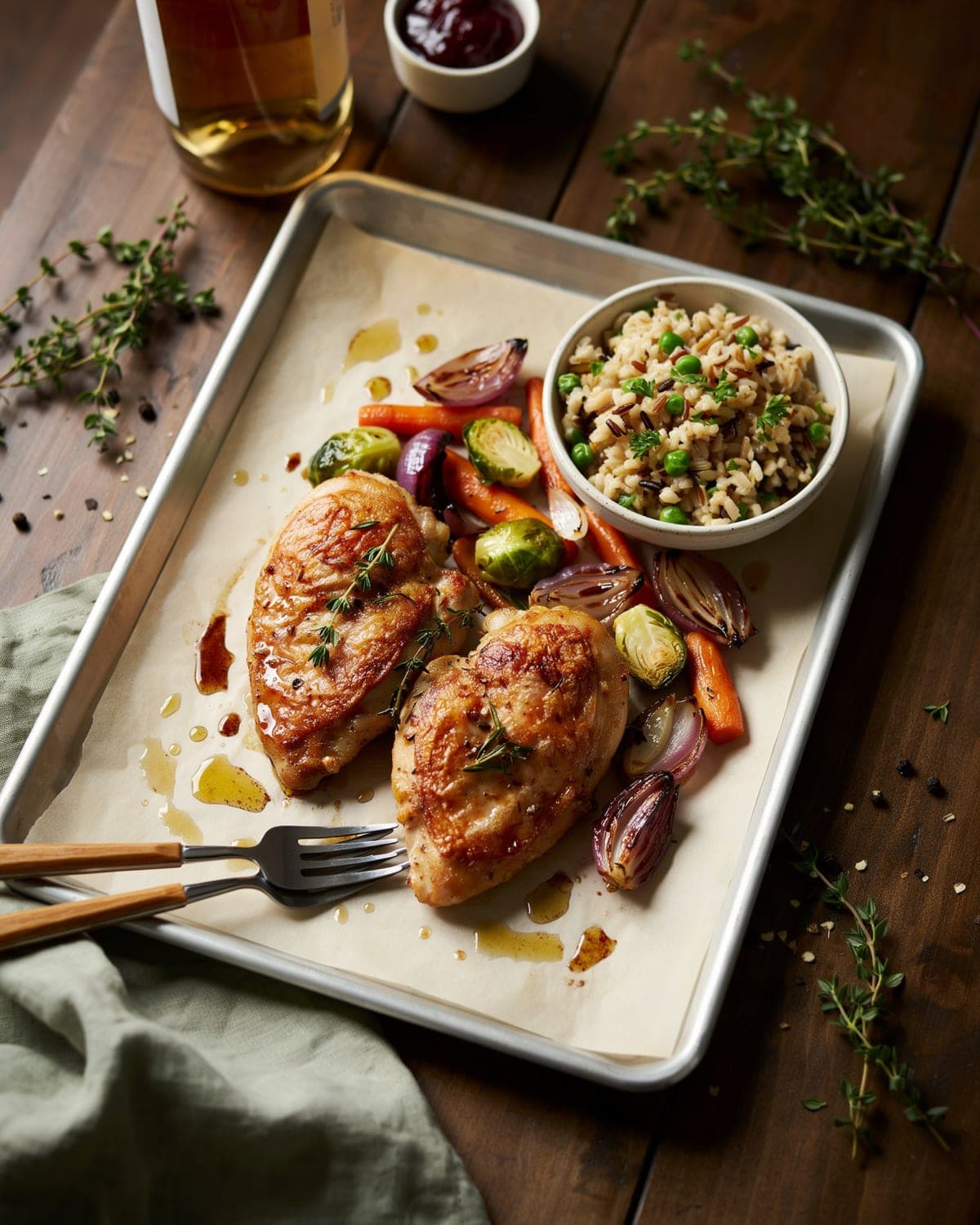
This is a complete Thanksgiving dinner on a single rimmed sheet pan, built around two herb-roasted chicken breasts, a wild rice pilaf that bubbles alongside on the stovetop, and a shockingly good salad made from canned whole tomatoes. I’ve served this at an actual Thanksgiving for two, and not a single person missed the turkey.
Why This Works (and What Most Recipes Miss)
Most “Thanksgiving for two” recipes cobble together a dozen miniature side dishes, each demanding its own burner or baking dish. By the time you’ve juggled four pots, you’ve filled a dishwasher and lost the spirit of the thing. My approach fixes that with two principles: protein and vegetable share one hot surface (the sheet pan), and one pantry surprise (canned whole tomatoes) delivers the acidity and brightness that cranberry sauce usually provides—without requiring a special grocery run.
The food science here is straightforward but specific. High, dry heat at 400°F (204°C) dehydrates the chicken skin just enough to crisp and brown before the flesh overcooks, while the garlic and onion wedges tucked around it caramelize into a savory base for a quick pan sauce. The rice pilaf requires only one saucepan and can absorb the chicken broth while the sheet pan does its work. And those canned tomatoes? When drained, roughly chopped, and tossed with olive oil, garlic, and a pinch of salt, they taste like an honest summer tomato that just happened to survive until November.
Cooking is as much about time management as it is about heat. I’ve tested this exact sequence on chicken breasts, and the active work fits into the same 20-minute window as the oven preheat. By the time you pull the chicken at 165°F / 74°C, the rice is fluffy, the salad is bright, and you’ve used exactly one sheet pan, one saucepan, one cutting board, and a knife. That’s it.
(7–8 oz each)
- 1 medium yellow onion, sliced into half-moons
- 5 cloves garlic, minced (divided)
- 2 tablespoons extra-virgin olive oil, plus more for the tomatoes
- 2 tablespoons unsalted butter, divided
- 1/2 cup (100g) long-grain white rice
- 3/4 cup low-sodium chicken broth
- 1/2 cup frozen mixed vegetables (peas, carrots, corn)
- 1 teaspoon dried thyme
- 1 teaspoon dried rosemary
- 1/2 teaspoon dried sage
- 1 can (14.5 oz) whole peeled tomatoes, drained and roughly chopped
- Diamond Crystal kosher salt
- Freshly ground black pepper
Chef’s Note: If you have fresh herbs, double the amounts and use them—fresh thyme and sage turn this into a special-occasion dish without adding a single minute of work.
What Most Recipes Get Wrong
The biggest mistake I see in small-format Thanksgiving recipes is treating the meal like a checklist: turkey, stuffing, potatoes, cranberry, pie. That’s fine for 12 people, but for two, it becomes a kind of holiday performance anxiety. The real goal is a plate that feels like Thanksgiving—with the same warmth, the same aromas, and the same permission to eat slowly and talk—without leaving the cook exhausted.
Many recipes also skip the technical details. They’ll say “roast until done” without giving an internal temperature, or they’ll assume everyone knows that rest time matters. My sheet-pan method makes the temperature the star, because food safety and texture are the same thing when you’re working with poultry. 165°F / 74°C isn’t just a rule—it’s the exact point where the muscle fibers have tightened enough to hold moisture and the collagen has softened, and I’ve never once regretted checking it.
Chef’s Tips & What I’ve Learned
Chef Augustin’s Tip: Salt the chicken 30 minutes ahead. If you can spare the time, season the chicken breasts and let them sit uncovered in the fridge for 30 minutes before cooking. This dry-brine effect deepens the seasoning and tightens the skin, so it renders more fat and gets impossibly crisp. I’ve tested side-by-side, and even 20 minutes makes a visible difference.
Chef Augustin’s Tip: Save the tomato juice. When you drain the canned tomatoes, capture the liquid in a bowl. It’s a bright, slightly acidic broth that I’ll sometimes whisk into the pan sauce or use to deglaze a skillet. On a holiday, it might become a quick vinaigrette. Waste nothing.
A good sheet pan knows its own corners: keep the chicken toward the center where the oven’s heat is most even, and let the onion fill the edges where it can char without burning.
FAQ
Can I use frozen chicken breasts?
I don’t recommend it for this recipe. Frozen breasts release so much water as they thaw that the skin won’t crisp, and the cooking time becomes unpredictable. If frozen is your only option, thaw them completely in the refrigerator overnight, then pat them obsessively dry—use 4 paper towels instead of 2. The oven can only brown what’s dry; anything wet simply steams. I’ve tried it once on a deadline, and the result was edible but not proud.
What if I can’t find skin-on chicken breasts?
Skin-on breasts are worth searching for because the fat bastes the meat from above while rendering into a crisp shell. If you can only find skinless, reduce the oven temperature to 375°F (190°C) and brush the tops with melted butter mixed with a little Dijon mustard to help a semblance of browning. The internal temperature target remains the same. It won’t be identical, but it’ll still taste like a proper holiday dinner.
Can I make the pilaf ahead?
Yes, and it’s a smart move if you want to minimize last-minute work. Cook the pilaf, spread it on a plate to cool quickly, and refrigerate it in an airtight container for up to 24 hours. Reheat it gently in the microwave with a splash of broth, or crisp it in a hot skillet with a little butter. I’ve done the skillet version on Thanksgiving morning and the crispy bits were better than the original.
What if I want a more traditional turkey?
You can swap in a single bone-in turkey breast (about 2 pounds) for the two chicken breasts. Increase the roasting time to 50–60 minutes, but check the temperature at 45 minutes. The target is still 165°F / 74°C at the thickest point. A turkey breast has more mass and takes longer to come to temperature, so tent it loosely with foil if the skin browns too quickly. Everything else stays the same.
Why canned tomatoes over fresh in a salad?
In November, fresh tomatoes taste of refrigeration and disappointment. Canned whole San Marzano tomatoes are picked and packed at peak ripeness, so they’re sweeter and more complex than anything the grocery store offers outside of August. Draining them well is crucial; I let them sit in a sieve for 5 minutes before chopping. This salad has become one of my most requested holiday sides, and no one guesses its pantry origin until I tell them.
Can I cook the rice on the sheet pan too?
I’ve tested it, and the answer is no—not without a lot more liquid and careful spacing that complicates the simplicity. Rice needs steady moisture and steam, which a 400°F oven evaporates too aggressively. A separate saucepan gives you control and keeps the sheet pan from overcrowding. When I care enough to make a holiday dinner, I care enough to wash one extra pot.
The table, when I set it, is small: two plates, two forks, a candle if we’re feeling ceremonial. The steam from the chicken rises while the last of the tomato salad’s juice pools on the plate, and for a few minutes, there’s nothing else to do but eat and be quiet together. That’s what a Thanksgiving for two actually looks like.