
Article and tips
One skillet, two sandwiches. Seventeen minutes, start to finish, and the only dish worth washing is the pan you cooked in. If you've seen the egg-flip sandwich method making the rounds, you already know the appeal: you pour beaten eggs straight into the pan, lay bread down on the wet egg, flip the whole thing like a pancake, and the bread toasts while the eggs set into a soft, even layer that fits the bread exactly. No spatula gymnastics, no separate egg scrambling, no dried-out patty of egg sliding out the back of the sandwich.
But here's the gap I kept running into: nearly every version of this technique is written for one sandwich, one egg, one slice of cheese. Scale it to two and things fall apart — the eggs set before the second slice of bread hits the pan, the cheese goes on at the wrong moment and never melts, and one sandwich ends up golden while its partner sits there pale and sad. I've made this for two people probably forty times now, and the fix is simple: a wide 12-inch skillet, eggs whisked with a little water for steam, and cheese layered under the fold instead of on top. Get those three things right and both sandwiches come out identical, which is exactly what you want when you're feeding someone you like.
This is the breakfast I make when we've got twenty minutes before the day starts and neither of us wants to think. It also works beautifully as a weeknight breakfast-for-dinner — which, if you've never tried it, is one of the small joys of cooking for two.
Why This Works
The egg-flip method is a small piece of kitchen engineering. When you pour beaten eggs into a buttered nonstick pan and lay bread directly on the liquid egg, the bread acts as a sponge and an anchor. As the eggs set, they bond to the bread's toasted surface — you're building an egg layer that is structurally part of the sandwich, not a filling that squirts out when you bite down.
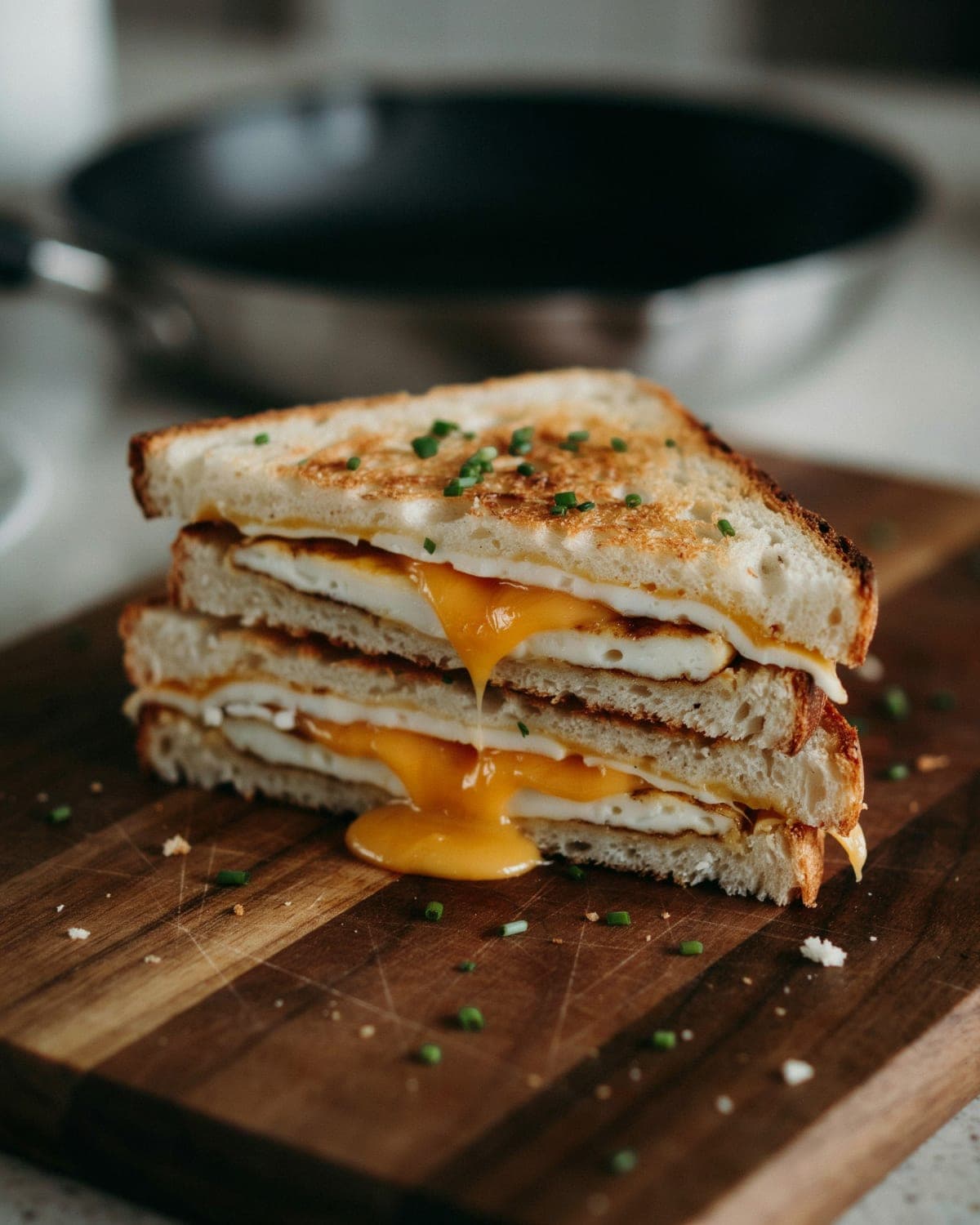
The water in the egg mixture matters more than it looks. Two teaspoons per four eggs creates just enough steam under a lid to puff the eggs slightly and cook them through from the top, so you're not flipping a wet, fragile sheet of egg. The cheese-under-the-fold trick is the other half: cheese placed on top of the eggs, then folded over, gets trapped between two warm layers and melts from residual heat alone. Cheese placed on top of everything else often never fully melts before the bread burns.
And the pan temperature is everything. Eggs set at around 160°F / 71°C, and bread toasts nicely starting around 300°F / 150°C pan surface temperature. Medium-low heat puts you in the sweet spot for both — high heat gives you rubbery eggs and scorched bread before the cheese even thinks about melting.
A folded egg is a cooked egg; a rushed egg is a rubber one. The pan decides which one you get.
What Most Recipes Get Wrong
Most one-pan egg sandwich recipes I've cooked through make the same pair of mistakes. First, they call for a small skillet — 9 or 10 inches — which forces the four-egg layer to be thick and slow-setting. By the time the eggs are ready for bread, the butter is browned and the first sandwich inherits a bitter edge. A 12-inch skillet gives you a thin, even egg layer that sets in under three minutes.
Second, the cheese placement. Nearly every version puts the cheese on top of the folded egg and hopes for the best. Cheese needs to be sandwiched between warm layers to melt; exposed cheese on a medium-low pan often stays firm while the bread beneath it goes past golden into dark. Tuck it under the fold and residual heat does the work — I've tested both placements side by side, and the difference is the difference between a melted sandwich and a layered one.
Chef's Tips & What I've Learned
Chef Augustin's Tip: Nonstick vs. cast iron — I've made this in both. Nonstick wins here because the thin egg sheet releases cleanly during the flip. Cast iron's rough surface grabs the egg at the edges, and a torn egg layer means two raggedy sandwiches instead of two tidy ones.
Chef Augustin's Tip: Cover the pan in Step 4. The lid traps steam and cooks the egg's top surface, so the flip doesn't fling loose egg across your stovetop. It also puffs the eggs slightly — a lighter sandwich with no extra work.
If you're the type who likes variety, split the chives between the egg mixture and the top. Chives cooked into eggs mellow; chives scattered fresh on top stay sharp. You get both flavors from one bunch.
Two eggs per person in a sandwich with cheese and buttered bread is a genuinely satisfying breakfast — the protein in the eggs and cheese carries you to lunch without a mid-morning raid on the snack drawer.
The whole thing lives or dies in a 90-second window between pouring the eggs and laying the bread. Have everything — cheese slices, spatula, lid, plate — within arm's reach before the butter goes in.
Frequently Asked Questions
What is a hobo egg?
A hobo egg is a rustic one-pan egg dish where an egg is cracked into a hole cut from a slice of bread and fried in the same pan — sometimes called "egg in a basket." The one pan breakfast sandwich for two here is a cousin of that idea: bread and eggs cooking together in one skillet, so the toast absorbs the egg. The egg-flip method takes it a step further by bonding an entire egg layer to the bread rather than just one yolk.
What's the egg-flip sandwich method, exactly?
You pour beaten eggs into a buttered skillet, lay bread directly on the wet egg, cook until the eggs are nearly set at around 160°F / 71°C, then flip the whole egg-and-bread sheet in one motion. The bread toasts against the pan while the eggs finish on top, and you fold the overhanging egg inward to build a perfectly proportioned sandwich. Four eggs, four bread slices, two flips — that's the entire technique, and it scales cleanly as long as your pan is wide enough.
Can I make these two sandwiches ahead of time?
You can, with one adjustment. Cook the sandwiches fully, cool them for 10 minutes, wrap in foil, and refrigerate for up to 2 days. Reheat in a dry skillet over medium-low for 3 to 4 minutes per side, or in a 350°F / 175°C oven for 10 minutes. The microwave works in a pinch — 60 to 90 seconds — but it softens the crust. The skillet reheat is worth the extra three minutes.
What bread works best for a one pan breakfast sandwich?
Sturdy bread cut about 1/2 inch (1.3 cm) thick: sourdough for tang and structure, brioche for a soft, rich crumb, or Texas toast for maximum crust surface. Thin sandwich bread (under 3/8 inch) is the one thing to avoid — it tears during the flip and can't support the folded egg layer. Whatever you choose, butter it evenly; bald spots stick to the pan.
Are two scrambled eggs on toast a filling breakfast?
Yes — two large eggs deliver about 12 grams of protein, and with a slice of cheddar on sourdough you're looking at roughly 25 to 30 grams of protein per sandwich here, plus fats and carbohydrates that keep energy steady through the morning. Since this version uses two eggs per person along with cheese, each sandwich comes in around 580 calories. Add a handful of fruit or a quick side of roasted cherry tomatoes if you want more on the plate.
My eggs tore when I flipped. What went wrong?
Three usual suspects: the pan was too small (a thick egg layer can't set before you flip), the heat was too high (the bottom seized while the top stayed wet), or you skipped the lid (no steam, so the surface never firmed). Fix all three — 12-inch skillet, medium-low, covered for 2 to 3 minutes — and the flip becomes almost boring. If a little egg still peeks over the edge, just fold it back in with your spatula; nobody will ever know.
Can I add meat or vegetables to this?
Absolutely. Cooked, crumbled breakfast sausage or crisped bacon can be sprinkled over the eggs before the flip — keep it to about 2 ounces (55g) per sandwich so the fold still closes. Sautéed spinach, sliced tomato, or caramelized onions work on the vegetable side; add wet vegetables sparingly, since moisture softens the toast. Everything still cooks in the same single pan.
The table's set, the pan is still warm, and the only evidence of cooking is one skillet in the sink and two half-eaten sandwiches between you. That's a morning done right.