
Article and tips
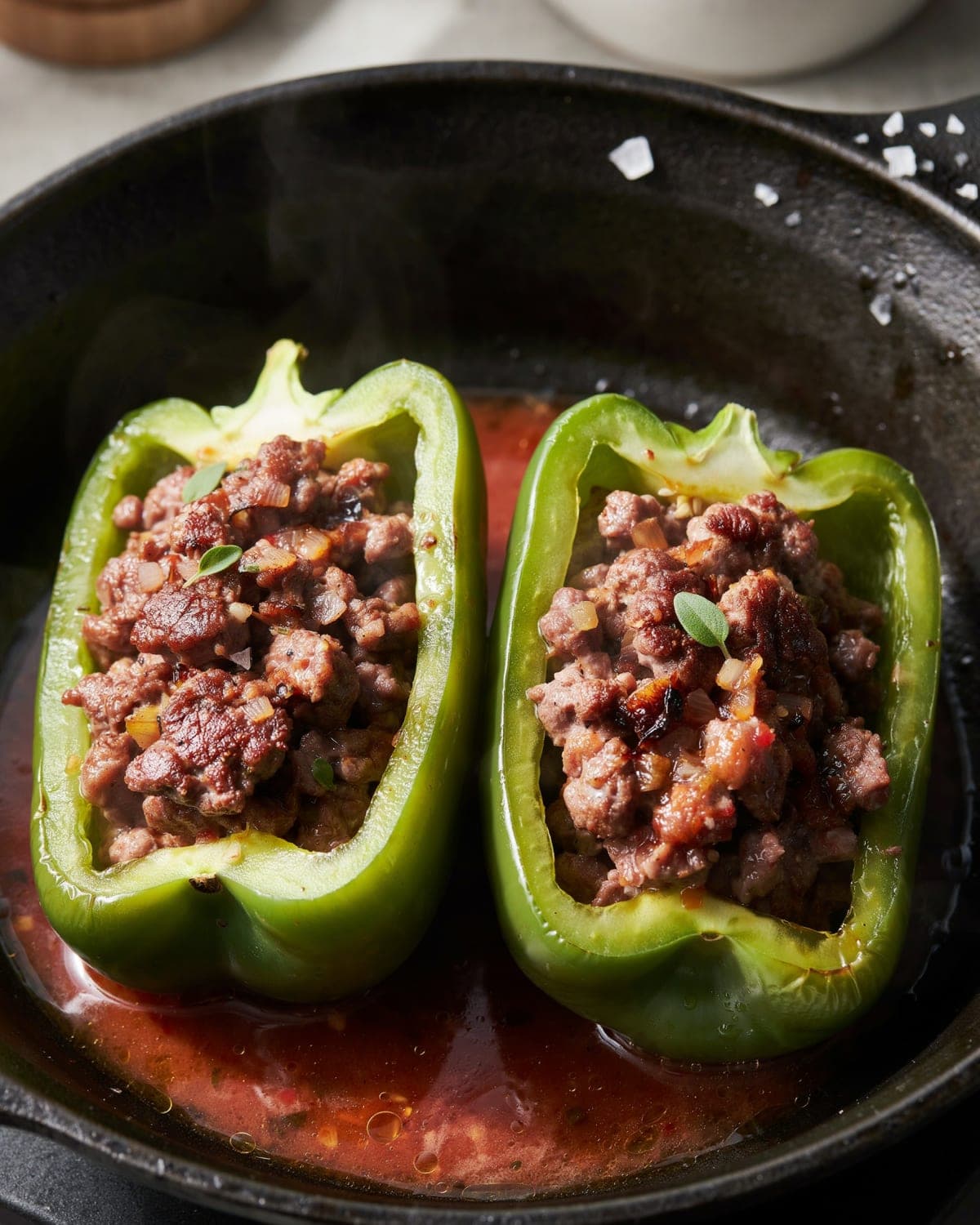
Most stuffed pepper recipes for two hand you a 45-to-60-minute bake with raw beef packed into raw shells, and what comes out of the oven is a pepper that slumps the moment your fork touches it. I stopped making them that way years ago. My version sears the ground beef first—so it hits 160°F / 71°C in the skillet, not in the oven—par-roasts the pepper halves while the filling comes together, and then finishes everything uncovered at high heat for barely ten minutes. The result is a pepper with structure, a filling that tastes browned instead of boiled, and a total time of 55 minutes, which is genuinely weeknight territory.
This is also the rare dinner-for-two recipe that scales honestly. Half a pound of ground beef, three-quarters of a cup of cooked rice, exactly two peppers—no half-can-of-tomato-sauce problem, no leftovers haunting the fridge. Everything here earns its place.
Why This Works
The whole method rests on one piece of food science: bell peppers don't need to be soft, they need to be cooked. A raw pepper's cell walls are rigid and waxy; at 425°F / 220°C for about 12 minutes, they break down just enough to turn sweet and tender-crisp without releasing the flood of water that turns a stuffed pepper into soup. Par-roasting empties that water onto the sheet pan instead of into your filling.
The second pillar is browning. When you pack raw beef into a pepper and bake it, the meat steams—trapped moisture pins the pan at 212°F / 100°C, far below the ~300°F the Maillard reaction actually needs. That's why so many stuffed peppers taste gray and faintly sweet. Searing the beef in a screaming-hot skillet gets the fond going, and then I deglaze with the canned tomatoes, which pulls every caramelized bit off the pan floor and into the sauce. You get the flavor of a 90-minute braise in about 8 minutes of actual cooking.
The rice matters too. Cooked, cooled rice absorbs tomato liquid without turning to paste. Fresh hot rice, straight from the pot, keeps releasing steam into the filling and can push your peppers toward mush. If you have rice from last night's dinner, this is its best possible second life.
How to Make Stuffed Peppers for Two
What Most Recipes Get Wrong
The mistake I keep seeing in stuffed pepper recipes is treating the oven as the only cooking tool. Raw filling into raw shells, bake at 350°F / 175°C for three-quarters of an hour, and hope. What actually happens is that the peppers weep water into the filling, the beef steams gray instead of searing brown, and everything arrives on the table tasting politely of nothing. The fix is sequencing, not effort: brown the meat on the stove, roast the shells empty first, and let the oven do only its best job—high, dry heat for browning. A second error is overfilling. Peppers shrink as they roast, but filling doesn't; a heaping mound above the rim will slump over the edge and scorch on the pan. Fill to the rim, level it, and let the cheese do the towering.
Chef's Tips & What I've Learned
Chef Augustin's Tip: Toast the cooked rice in the dry skillet for 90 seconds — the same move that builds fond in a chicken skillet dinner — before folding in the tomato mixture. The grains get a light crackle and pick up the beef fond, which is why restaurant stuffed fillings taste deeper than home versions.
Chef Augustin's Tip: Salt the beef, not the peppers. Peppers released their water at the par-roast stage; salting them again just pulls out more. All your seasoning belongs in the filling.
I've made this with cast iron and with stainless steel, and cast iron wins—it holds roughly four times more thermal mass, so the beef crusts instead of cooling the pan the moment it hits. If your skillet is thin stainless, work in two smaller batches.
A pepper with a wobble doesn't deserve your filling. Test them: if a half tips over when nudged, trim a whisper-thin slice from the base to make a flat seat.
Green bell peppers are the traditional choice and they work fine here—just know they're harvested earlier, so they're more bitter and less forgiving. I use them only when they look firmer than the reds at the market.
Frequently Asked Questions
Do peppers have to be cooked before stuffing?
They don't have to be, but I strongly recommend a 12-minute par-roast at 425°F / 220°C. Raw shells need 35 to 45 minutes in the oven to soften, and by then your filling has dried out or your cheese has scorched. Par-roasting front-loads the pepper's cooking time while your filling comes together on the stove, so nothing waits for anything. It also drives off the water trapped between the pepper's cell walls—roughly 2 tablespoons per half in my kitchen—which is the single biggest cause of soupy stuffed peppers. Skip it and you'll spend the whole meal chasing loose rice around the plate.
What's a good filling for stuffed peppers besides beef and rice?
The formula I trust is: one protein (1/2 lb / 225g), one starch (3/4 cup / 130g cooked), one sauce or binder (1/2 cup / 120g), one aromatics base, one melter. Ground turkey with quinoa and salsa, with pepper Jack on top, hits 165°F / 74°C and goes Southwestern with a teaspoon of chili powder. For a meatless version, swap in 1 cup (170g) of cooked lentils—the binding behavior is nearly identical to beef. Whatever you choose, cook the protein fully before it enters the pepper. The oven's 10-minute finish isn't enough to take raw meat to a safe temperature evenly.
Can I make stuffed peppers for two ahead of time?
Yes, with one condition: stop before the cheese. Complete Steps 1 through 6, let the stuffed shells cool to room temperature (about 30 minutes), then refrigerate uncovered for up to 24 hours. When you're ready, bake at 425°F / 220°C for 15 to 18 minutes instead of 10 to 12—you're heating a cold filling all the way through to at least 160°F / 71°C in the center, which takes longer. Add the cheese for the final 5 minutes so it melts fresh instead of reheating rubbery. I don't recommend freezing the assembled peppers; the shells turn watery on thaw and never regain their snap.
Why is my stuffed pepper filling watery?
Three usual suspects, in order of likelihood. First, uncooked or freshly cooked rice: hot rice keeps steaming and pushes moisture into the filling, while day-old rice absorbs it—cool your rice at least 30 minutes. Second, skipping the par-roast, which leaves the pepper's own water to drain into the filling mid-bake; that's roughly 2 tablespoons per half. Third, using diced canned tomatoes with their juice instead of crushed—I drain nothing, but I use thick crushed tomatoes at 1/2 cup (120g) precisely because they bind. If your filling still feels loose in the skillet at Step 5, simmer it 2 more minutes before stuffing. Thickness in the pan is thickness on the plate.
Can I use ground chicken or turkey instead of beef?
Absolutely—just shift your safety temperature. Ground poultry must reach 165°F / 74°C in the skillet, versus 160°F / 71°C for ground beef, and poultry's lower fat content changes the pan behavior: add 1 teaspoon of olive oil, keep the heat at medium rather than medium-high, and expect browning to take 7 to 8 minutes instead of 5 to 6. Turkey's milder flavor benefits from a bolder hand with the smoked paprika—bump it to a full teaspoon—and the Worcestershire stays in. The rest of the method is identical: same 12-minute par-roast, same 10-to-12-minute finish. The filling will be a touch leaner, which the cheese more than covers.
How do I store and reheat leftovers?
Refrigerate in an airtight container for up to 3 days. To reheat, place the peppers in a small baking dish with a tablespoon of water in the bottom, cover with foil, and warm at 350°F / 175°C for 15 minutes, then uncover for 5 more to re-crisp the cheese. The foil-steam method keeps the shells tender without turning them to mush. A microwave works in a pinch—90 seconds at 70% power—but you'll lose the blistered edges that make this dish. And because the filling contains fully cooked beef held at safe temperatures throughout, reheating is about texture, never safety. One pepper reheats better than two, so I'd cook both on night one; they rarely survive to night two anyway.
The oven clock ticks down, the cheese goes from white to gold at the edges, and the kitchen smells like a Tuesday that decided to show off. Two plates, two peppers, a fork breaking through the shell with a quiet crack. Pour something cold, sit across from your person, and eat while it's still too hot to hurry.