
Article and tips
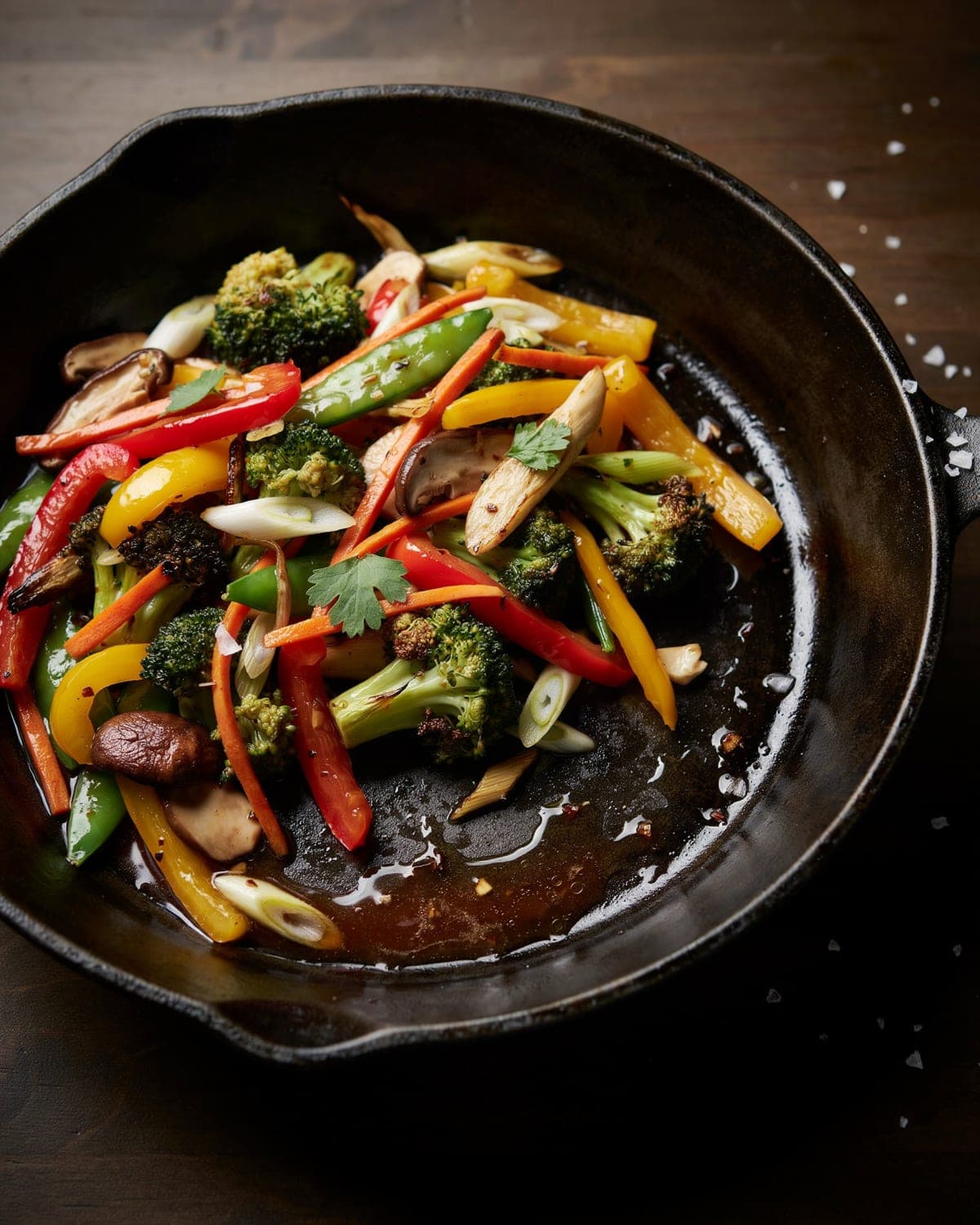
A bag of frozen stir-fry vegetables, one screaming-hot skillet, and a sauce measured to the tablespoon — that is the entire plan.
Most stir fry recipes I've cooked from are written for a table of six. When I halve them, two things break: a small batch of cold vegetables in a big pan never gets hot enough to sear, and the sauce — eyeballed rather than measured — turns into soup at the bottom. This recipe is built for two from the first tablespoon. The vegetable quantities, the sauce ratio, and the cooking order are all scaled to a 12-inch skillet and two plates, and it leans on the bag of frozen stir-fry vegetables already in your freezer, which keeps prep to ten minutes. The technique here — sear hard, sauce late — is one you will reuse every single week.
Stir fry is not a recipe so much as a sequence. Learn the order, and you can improvise the rest forever.
Why This Works
A stir fry lives or dies at the surface of the pan. Vegetables sear when the cooking surface sits above roughly 350°F (175°C); below that, they release moisture faster than the pan can boil it away, and they end up simmering in their own liquid instead of charring at the edges. I've watched the surface of an overcrowded skillet fall from about 500°F (260°C) to under 350°F (175°C) the moment a full family-size batch went in — that is the steam-braise zone, and it is why crowded stir fry tastes wet and gray instead of blistered and sweet.
Frozen stir-fry vegetables solve the prep problem but create a moisture problem. They are blanched before freezing, so their cell walls are already tender; the only obstacle is the film of ice on every piece. That is why this recipe adds them straight from the freezer in a single layer and leaves them alone for two full minutes — the ice evaporates with a hiss, the surfaces dry out, and then they sear. Thaw them first and you are cooking vegetables that are already half soft.
The sauce is where Harold McGee's On Food and Cooking earns its shelf space: cornstarch reaches full thickening power just below a simmer, which is why the glaze goes from milky to glossy in the last twenty seconds. Pour it around the hot perimeter of the pan — where the metal is hottest — and it sets on contact instead of pooling in the middle.
I've cooked this exact recipe in nonstick, cast iron, and carbon steel. Carbon steel wins because it recovers its temperature in seconds after the cold vegetables hit; cast iron is a close second; thin nonstick struggles to hold 400°F (200°C).
Heat is an ingredient here. Everything else is negotiable.
What Most Recipes Get Wrong
The mistake I keep seeing in small-batch stir fry is a sauce written for six and eyeballed for two. A family-size recipe might call for a third of a cup of soy sauce alongside heaps of vegetables; scaled down carelessly, that same generosity drowns a twelve-ounce bag. Measure the sauce — three tablespoons of soy, not a splash — and the pan stays glossy instead of soupy.
Second: thawing or rinsing frozen vegetables before they hit the pan. They are already blanched; water is the one thing they cannot absorb gracefully. Straight from the freezer, hot dry pan, single layer — that is the whole trick.
Third: a pan that is too small. Twelve ounces of vegetables plus an onion and a pepper need a 12-inch skillet to sit in one layer. In an 8-inch pan the same batch stacks three deep, the surface temperature collapses, and everything steams.
Fourth: extra-virgin olive oil in a searing-hot pan, and garlic in from the first second. Aromatics added at the start burn long before dense carrots turn tender — they belong in a clear well, in the last forty-five seconds.
Chef's Tips & What I've Learned
Chef Augustin's Tip: Trust the water test. When a flicked droplet skitters instead of spreading, the surface is around 400°F (200°C) — hot enough to evaporate vegetable moisture as fast as the vegetables release it. That balance point is the entire difference between searing and stewing.
Chef Augustin's Tip: Get everything within reach before the oil goes in. A stir fry moves in thirty-second windows and the pan only goes forward — there is no pausing to hunt for the sesame oil while garlic sits on hot metal. Sauce whisked, rice warm, garnish chopped, bowls out.
Chef Augustin's Tip: Season at the end, not the beginning. The sauce reduces as it glazes and concentrates its salt; taste after Step 6 and adjust with a few drops of soy sauce or a splash of vinegar before anything reaches the table.
One habit that changed my weeknights: I keep peeled ginger in the freezer and grate it straight into the pan, frozen. It is faster than mincing, it never molds in the crisper drawer, and it blooms in the hot oil in seconds.
A stir fry rewards the cook who is ready, not the cook who is careful.
Vegetable Stir Fry for Two: Frequently Asked Questions
Can I use fresh vegetables instead of frozen?
Yes, and fresh sears even more cleanly. For two, aim for about twelve ounces total: one cup broccoli florets, one carrot cut into coins, one cup snap peas or bell pepper strips. Cook in order of density — carrots and broccoli for three to four minutes, then the tender vegetables for two — and keep everything else identical. The sauce stays the same either way; it is calibrated to twelve ounces of vegetables, frozen or fresh.
Why are my frozen stir-fry vegetables soggy?
Three usual causes. The vegetables were thawed before cooking, which pushes already-blanched cell walls past soft. The pan was not hot enough when they went in, so they simmered in their own meltwater. Or they were stirred constantly, which keeps surfaces wet and never lets them brown. Fix all three at once: screaming-hot pan, straight from the freezer, a single layer, and two full minutes of not touching them — then stir-fry in long, unhurried tosses rather than constant scraping.
How long does vegetable stir fry for two last in the fridge?
Three to four days in an airtight container — the USDA window for cooked leftovers, and it applies to the rice too. Cool everything quickly, within two hours, and refrigerate. To reheat, warm the stir fry in a skillet over medium-high for three to four minutes with a teaspoon of water to loosen the glaze, until it is steaming and 165°F (74°C) at the center. The microwave works, but the skillet brings back some of the sear.
Can you freeze vegetable stir fry for two?
You can, for up to two months, with one texture trade-off: high-water vegetables like bell peppers and snap peas soften in the freezer and stay soft after thawing, while broccoli and carrots hold up well. Freeze the cooked stir fry flat in a freezer bag, thaw overnight in the refrigerator, and reheat in a hot skillet to 165°F (74°C). My preferred move is freezing the sauce on its own — it survives perfectly — and stir-frying a fresh batch of vegetables in minutes.
What should I serve with vegetable stir fry for two?
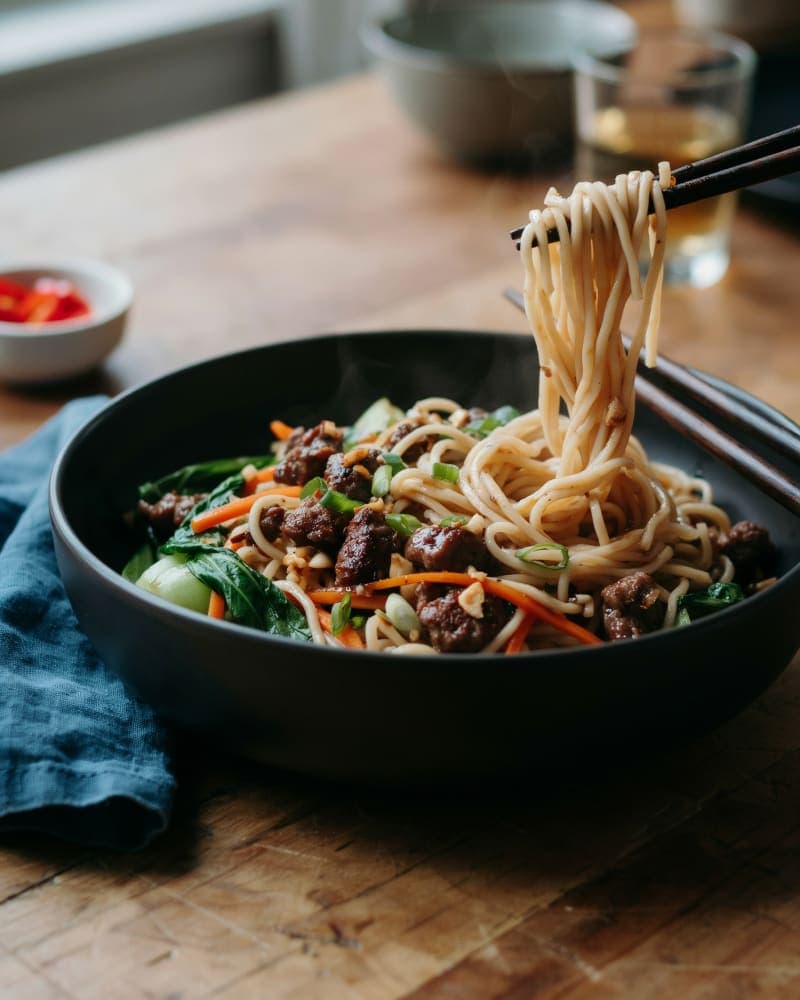
Warm jasmine rice is the default — two cups cooked, started first if you do not have leftover. Noodles work too: six ounces of lo mein or ramen, cooked and tossed into the pan at Step 6. A fried egg on top is my favorite upgrade; cook it until the whites are fully set and the yolk is thickened, and if you like it runnier, the FDA recommends pasteurized eggs for runny yolks. Steamed dumplings or a five-minute cucumber salad round out the table without another pan.
Can I add protein to this stir fry?
Yes — the pan has room for one add-in without losing its heat. For chicken, stir-fry eight ounces of thinly sliced chicken breast in the hot oil first, four to five minutes, until it reaches 165°F (74°C) internally, then remove it and return it to the pan with the sauce. Two scrambled eggs can go into the well at Step 5. For a vegetarian staple, press and cube half a block of firm tofu, then sear it in the hot pan until golden on every side before the vegetables go in.
Is vegetable stir fry for two a balanced weeknight dinner?
With the controls in your hands, yes. Twelve ounces of vegetables across two plates is a generous portion of several colors; the oil is measured at two tablespoons for the whole pan; and low-sodium soy sauce keeps salt in check while rice vinegar and ginger carry the flavor instead. Add the egg or tofu above and you have protein too. It is a weeknight plate where every variable — sodium, oil, vegetables — is one you set yourself.
Then it is two bowls on the counter, steam climbing the backsplash, the glaze still glossy where the spoon dragged through it. One of you gets the scallions; the other gets the last of the snap peas, hunted down with a fork while the pan cools on the stove. Tuesday, handled.